
Which system should you evaluate first?
Start with the model, latency target and available facility capacity. NVIDIA H200 SXM provides 141 GB of HBM3e per GPU; NVIDIA lists 288 GB per B300 SXM GPU in its HGX reference architecture. That additional memory can change whether a model, context and runtime fit within a particular deployment, but memory capacity alone does not establish throughput, cost or the best server for a specific workload.
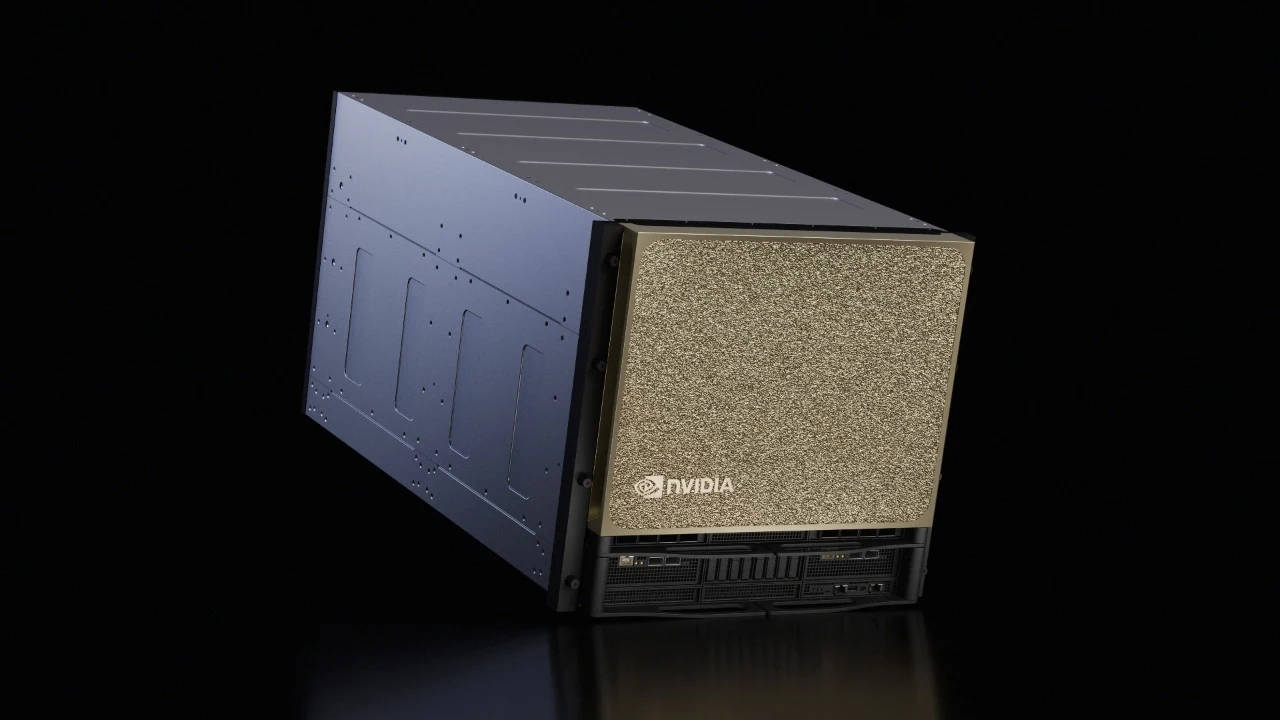
H200 belongs to the Hopper generation and B300 to Blackwell Ultra. An HGX H200 node and an NVIDIA DGX B300 are complete systems with different designs. A meaningful comparison needs the exact server SKU, installed parts, power and cooling requirements, compatible software, warranty and commercial terms. Do not treat figures for the DGX B300 as specifications for every third-party B300 server.
Compare the accelerator specifications
| Specification | H200 SXM | B300 SXM |
|---|---|---|
| Architecture generation | Hopper | Blackwell Ultra |
| GPU memory per accelerator | 141 GB HBM3e | 288 GB HBM3e |
| GPU memory on eight accelerators | 1,128 GB, about 1.1 TB | 2,304 GB, about 2.3 TB |
| Nominal HBM bandwidth per GPU | 4.8 TB/s | Up to 8 TB/s |
| Example system | OEM HGX H200 server | NVIDIA DGX B300 |
These are manufacturer specifications, not application benchmarks. The aggregate capacity is distributed across eight GPUs; it is not a single continuously addressable 1.1 TB or 2.3 TB GPU allocation. The software must support the intended distribution of weights, computations and cache. Vendor capacity figures may also use different rounding or decimal versus binary conventions, so compare the underlying units as well as the printed totals.
The ratio of the published capacities is 288 ÷ 141, or approximately 2.04. That means a B300 has just over twice the nominal memory of an H200 SXM in this comparison. It does not mean inference will be twice as fast or that a complete deployment will cost half as much per token.
Use a memory budget, not a model name alone
For a rough starting point, estimate weight storage from parameter count and effective bytes per parameter. A 70-billion-parameter model stored at two bytes per parameter needs roughly 140 GB for weights alone in decimal units. It also needs KV cache, runtime allocations and working buffers; quantization and sharding change the result. A 141 GB GPU cannot be assumed to run that complete workload simply because the weight-only estimate is below 141 GB.
Next, include the intended prompt length, maximum output, concurrent requests, batch policy and software stack. For training, add gradients, optimizer state and activations as applicable. Ask the team running the application to measure peak GPU allocations under a representative workload and retain operational headroom. An estimate is useful for screening candidates; it is not a replacement for an observed workload profile.
If H200 fits the target with headroom, compare it with B300 on measured performance and total system economics. If it does not fit, test alternatives: a supported multi-GPU layout, quantization where quality permits, reduced concurrency or context, or a higher-memory system. Each changes the trade-off; none should be assumed to work without validation.
What HBM bandwidth can and cannot predict
NVIDIA's reference architecture lists 4.8 TB/s per H200 SXM and up to 8 TB/s per B300 SXM. This is GPU memory bandwidth, not external networking or GPU-to-GPU bandwidth. It can matter when a workload repeatedly reads large quantities of model data, but end-to-end performance also depends on compute, communication, batching, kernels, storage and the model implementation.
Measure time to first token, token generation rate, request throughput and tail latency at the same concurrency and service-level target. For training, compare useful work per unit time and the time needed to reach the same training objective. Keep precision, model revision and software settings consistent where possible; when they cannot match, record the differences. An isolated peak specification is not a reliable substitute for such a comparison.
Compare complete systems and facilities
One H200 example is the 5U GIGABYTE G593-SD1-AAX3 built around an HGX H200 platform. NVIDIA's DGX B300 user guide describes an integrated 10-rack-unit system with eight B300 GPUs. These examples differ in more than their accelerators: CPU, memory, networking, storage, chassis, power delivery and support terms can all affect the decision.
NVIDIA lists 14.5 kW power consumption in the DGX B300 user guide; the product datasheet distinguishes busbar and power-supply configurations. Use the documentation and quoted configuration for the exact revision being considered. Do not apply a DGX power number to an OEM B300 server, and do not equate power-supply nameplate capacity with measured draw.
Before ordering, have the facility team confirm electrical feeds, redundancy, connector and circuit capacity, rack depth and weight, airflow and service clearances. Where an offer involves a power shelf or busbar, include that supporting infrastructure in the site plan and cost. Availability and delivery terms must be checked for the relevant market and date.
A practical comparison protocol
- Define the target: model and revision, precision, request mix, context and output lengths, concurrency, service-level objectives and expected utilisation.
- Obtain a complete bill of materials for each candidate, including GPU topology, CPU, RAM, storage, network cards, cables, power equipment and software support.
- Run a representative benchmark or obtain a documented result that matches the workload. Record runtime versions, configuration and whether measurements are end-to-end.
- Compare usable throughput at the required latency rather than peak throughput at an unacceptable response time. Record peak memory and GPU utilisation alongside the result.
- Estimate cost for the same workload period: equipment, support, software, network, energy and facility costs. State utilisation and energy-price assumptions explicitly.
- Verify warranty, supplier, documentation, delivery route and acceptance criteria for the exact offer. Do not infer local availability or price from an international announcement.
When power and cooling are limiting factors, the fastest GPU on paper may not be the system that can be deployed first. Conversely, if memory or the measured service target requires a larger device, a lower initial equipment cost may not deliver the desired capacity. Compare the deployment as a whole.
For a closer look at the eight-GPU H200 platform, read the H200 system guide. Explore H200 and DGX B300 configurations, or contact AI Server Lab with the workload and site constraints. Prices, availability and final specifications are confirmed for each request.