
UK-based ThermAI and Airsys describe HeatBridge as a way to transfer GPU-server heat into domestic heating and hot water. Airsys' 12 November 2026 announcement describes a six-GPU NVIDIA RTX PRO 6000 Blackwell Server Edition node and a heat-recovery prototype scheduled for display at SC26 on 17–19 November.
Airsys calls HeatBridge a prototype. Conditions described for participating UK households cannot be assumed for another market or an ordinary data centre. The idea connects compute cooling with heat use, but the outcome depends on temperature, demand, storage and GPU operating patterns.
What is described
According to Airsys, also available as a press-release copy, each installation pairs a six-GPU ThermAI Node with HeatBridge. 2CRSi builds the servers through a UK subsidiary. Airsys identifies RTX PRO 6000 Blackwell Server Edition GPUs with 96 GB of memory each.
ThermAI's FlightDeck is described as remote access to UK-hosted GPU resources, with plans for a distributed network of installations. The announcement does not give all specifications of a mass-market product, independent long-term operating results or a confirmed price for other countries. HeatBridge is explicitly described as a prototype.
Six times 96 GB is 576 GB of nominal aggregate GPU memory. This is memory across separate devices, not one local array. A single model requires a compatible distribution method and inter-GPU communication; independent models are constrained by their assigned device's usable memory.
Cooling and heat transfer
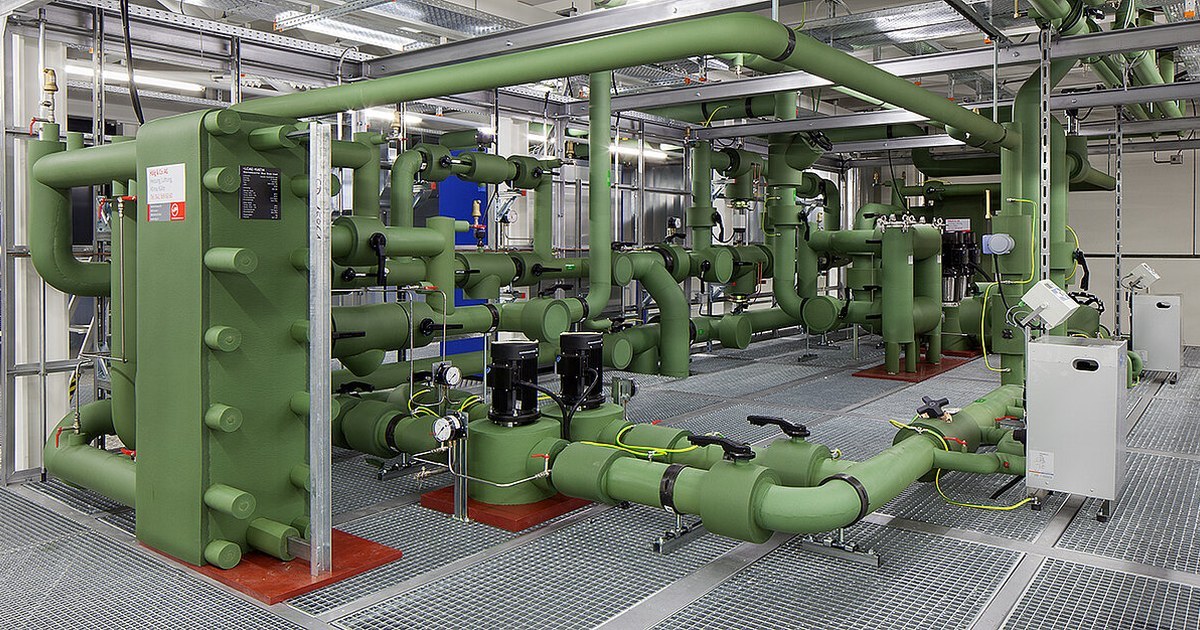
Airsys says LiquidPack sprays a non-conductive fluid onto hardware inside a sealed cassette. A heat exchanger transfers recovered heat to a water circuit, and Sunamp thermal batteries are intended to store it until needed. Airsys claims outlet water temperature up to 60 °C for the described system.
“Up to” is not a constant temperature under every load. The announcement lacks enough detail to calculate annual heat utilisation, component efficiency or user costs in another country. Local heating requirements, supply and return temperatures, safety and real demand all matter.
Spray cooling also does not eliminate auxiliary energy. Pumps, controls, heat loss and any additional cooling must be included in a full-system measurement. If results are published later, inspect measurement boundaries and observation duration.
An illustrative energy calculation
Suppose six GPUs each average 400 W for six hours. GPU electricity use is 6 × 0.4 × 6 = 14.4 kWh. This is a hypothetical GPU-only calculation, not a ThermAI measurement; host CPUs, network and other components are excluded.
Equipment electricity ultimately becomes mostly heat, but not all of it necessarily reaches the useful water circuit when needed. If an illustrative 70% of the 14.4 kWh reached a user, that would be about 10.1 kWh. The 70% is an invented assumption to show the arithmetic, not an Airsys claim or HeatBridge estimate.
A real calculation needs measured flow and temperatures, duration and operating profile, plus pump energy and storage losses. Economics also require local tariffs, the alternative heat source and equipment cost. Those data are needed before claiming payback.
Compute and heat demand may not coincide
A home may need more heat in the morning and evening while GPU jobs arrive at different times. Summer heating demand falls even if compute demand remains. Storage can shift heat use, but its capacity and losses are finite.
Build hourly profiles for useful heat demand and expected server load. Mark periods of surplus and shortage, then identify backup heat and excess-heat disposal requirements. Do not assume GPU jobs can be interrupted to regulate heating: a compute service can have availability and latency commitments.
Distributed installations also need network access, remote management and physical security. Outside a conventional data centre, define responsibility for access, maintenance, energy metering and incident handling. Cooling hardware alone does not resolve those operational questions.
Site checklist
Request exact GPU and server SKUs, input electrical power, heat balance, permitted fluid parameters and pump-failure behaviour. Agree fluid quality, leak detection and maintenance with the manufacturer and qualified facility specialists. Electrical and heating work must follow applicable local requirements.
For compute, document drivers, supported models, network requirements and monitoring. For heat, document required temperatures, the annual demand profile, storage and backup disposal. A pilot should measure completed jobs, electricity use and delivered heat at the same time.
What it means for server selection
The ThermAI prototype illustrates a potential heat-reuse approach in a UK project. Its stated conditions cannot be applied to another site without engineering and measurement. Start with the compute workload and confirmed electrical and cooling compatibility, then assess whether there is a nearby heat consumer at a suitable temperature.
Discuss a server configuration through the AI Server Lab catalog and contact form. Availability, configuration, price and delivery require confirmation.