
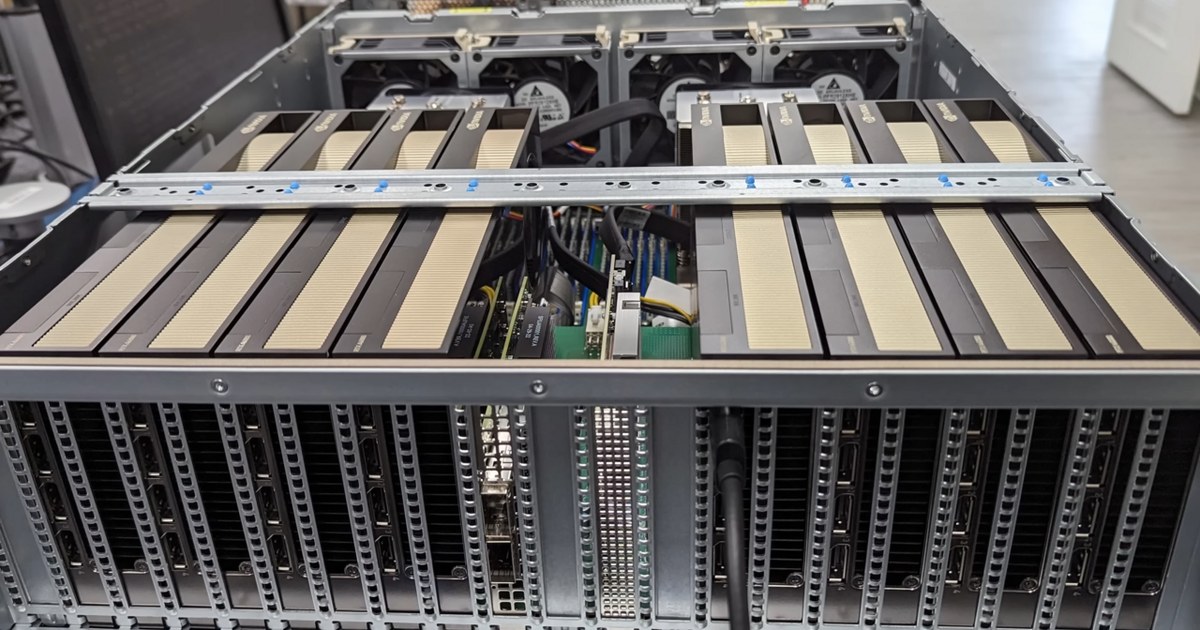
The practical answer: on November 11, 2026, Supermicro said it had begun shipping its H15 server portfolio powered by sixth-generation AMD EPYC 9006 processors. The manufacturer names Hyper, CloudDC, FlexTwin, GrandTwin, storage and SuperBlade systems. This is a family of commercial platforms, not a single server with a fixed GPU configuration. The announcement does not confirm price, inventory or delivery dates for a specific SKU in Russia.
The news follows AMD's EPYC 9006 launch, but buyers should focus on how the processor family is implemented in individual chassis. Single-socket CloudDC, dual-socket Hyper and liquid-cooled multi-node FlexTwin serve different roles and need separate evaluation of power, networking and accelerator compatibility. Vendor-reported gains should not be treated as a performance guarantee for an unrelated workload.
What is confirmed
Supermicro's November 11 announcement states that the H15 portfolio is shipping and describes systems intended for cloud, HPC, agentic AI infrastructure and enterprise workloads. It also discusses Helios and Helion rack-scale initiatives; those are separate platforms and should not be assumed to be included with every H15 server.
The release is not a Russian price list or proof that every CPU, accelerator, chassis and PSU option is available in every country. It references servers across SP7 and SP8 sockets, but the delivery status of a specific combination must be confirmed by part number. Ask for the seller, bill of materials, service conditions and destination-country documentation before ordering.
Supermicro cites comparative figures and SPEC CPU results. Those are vendor claims made under particular test conditions. Without the benchmark version, baseline, configuration and settings, they cannot establish the speed of a customer's AI service. Obtain a representative workload result or define a reproducible acceptance profile.
Platforms named by the manufacturer
| Family | Supermicro's description | Configuration question |
|---|---|---|
| Hyper | Dual-socket platform for enterprise, cloud and other workloads | Which GPUs and network cards does the exact SKU support? |
| CloudDC | Single-socket system for cloud infrastructure | Which risers, drives and cooling options are included? |
| FlexTwin | Liquid-cooled, two-node high-density design | How are the coolant loop, service and redundancy arranged? |
| GrandTwin | High-density 2U, two-node architecture | Which resources and network ports belong to each node? |
| Petascale Storage | Storage platform for data infrastructure | Which drives, controllers and protection are specified? |
| SuperBlade | Blade systems with air- and liquid-cooled options | Which enclosure, power and network components are needed? |
These are categories from the release, not a universal GPU support table. Support for a card in one system does not establish support in another. Obtain the exact product guide, supported accelerator list and a versioned configuration document for the chosen server.
The host CPU in a GPU workload
A CPU may load and prepare training data, schedule tasks, process requests and coordinate network transfers. An agentic application can also run tools, retrieval and other service components on host CPUs. Their importance varies with the software: a high core count alone does not prove that the CPU is the bottleneck.
Describe expected concurrency, host-memory consumption, data movement and the components that actually execute on the CPU. Then measure a representative workload. A comparison based only on maximum core count can miss limitations in memory configuration, networking or the application itself.
For example, a team may place GPU inference and document retrieval on the same node. The useful exercise is to measure CPU usage at the target request peak, memory consumed by retrieval and the runtime's overhead. This is a test scenario, not a claim that a particular H15 system can handle a fixed number of users.
Check GPU support and PCIe topology
The release refers to platforms optimised for accelerators including AMD Instinct, but it does not provide a universal GPU matrix for all H15 chassis. Request the supported card part numbers, count, form factor, host interface, risers and thermal components for the proposed SKU. Verify the chosen operating system, driver and AI libraries separately.
Supermicro's comparison of PCIe bandwidth is a manufacturer claim about platform capabilities; it does not establish a proportional end-to-end speedup for an application. Lane count, generation and the path through the processor or switch need to be checked against the motherboard diagram. A card that physically fits may still be unsupported for power or cooling reasons.
For a workload requiring GPU-to-GPU exchange, ask for the supported topology and interconnect. For communication between nodes, specify NICs, switches, cables and the intended RDMA stack. The H15 family name alone does not answer those questions.
Cooling and facility requirements
The named lines use different cooling approaches. The release describes FlexTwin as liquid cooled and SuperBlade with air- and liquid-cooled options. It does not establish that all chassis use the same coolant interfaces or can be attached to an existing facility loop without modification.
For an air-cooled build, obtain the supported inlet-temperature range, airflow, maximum heat and service clearances. For a liquid-cooled build, request coolant quality, flow, pressure, connectors, leak monitoring and the boundary between the server equipment and facility system. A qualified site engineer should validate the exact supplied configuration.
Compare complete configurations
Suppose a supplier proposes a single-socket and a dual-socket system in the same family. To compare them, hold the application, model, workload, concurrency and quality target constant. Measure host utilisation, latency, throughput and power at the relevant load.
If the GPU or network is the constraint, additional CPU cores may not produce a proportional gain. Conversely, insufficient CPU data preparation can leave accelerators idle. Both are hypotheses for testing, not performance results for a named H15 model. Include memory population, network components, maintenance and confirmed delivery terms in the cost comparison.
Questions to include in the request
- What is the exact H15 server SKU and supported CPU option?
- Which DIMMs, drives, accelerators and network adapters are included by part number?
- What risers, PCIe topology and software versions are supported?
- What is the maximum power and redundancy configuration for that BOM?
- If liquid cooled, what are the facility connection and service requirements?
- Which workload and acceptance criteria will be used for validation?
- What seller, availability, price, delivery and warranty apply in the destination country?
Explore the AI server catalog or describe the intended workload using the contact form. Configuration and commercial terms are confirmed separately for each enquiry.