
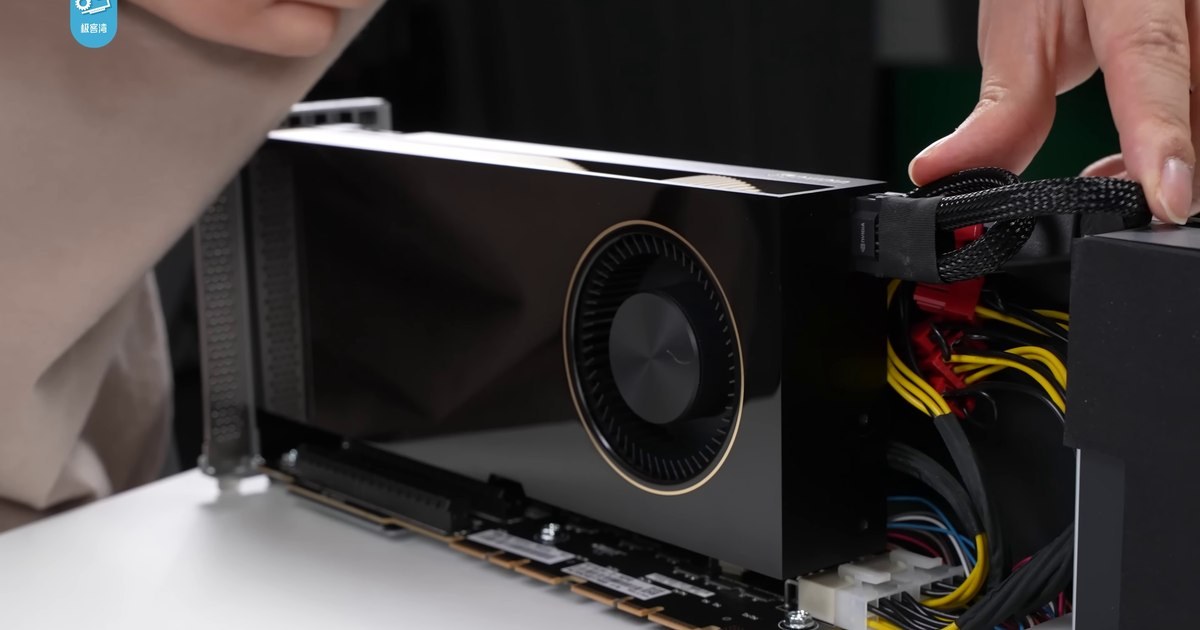
NVIDIA's RTX PRO 6000 Blackwell Server Edition and L40S differ in more than generation. NVIDIA specifies 96 GB of GDDR7 for the RTX PRO 6000 Server Edition and 48 GB of GDDR6 for L40S. That can change how a model and request cache fit, but it does not establish application speed or make two L40S cards equivalent to one RTX PRO 6000.
If a model and its working memory fit on one GPU, a single-device deployment is worth testing. If they do not, the engine must support a compatible distribution or model representation. Choose using the actual model, precision, concurrency, latency target, server design and confirmed commercial offer.
Specifications and limits
NVIDIA's RTX PRO 6000 Blackwell Server Edition page lists 96 GB of GDDR7 with ECC, 1,597 GB/s memory bandwidth and up to 600 W configurable power. It describes a dual-slot air-cooled form and a separate liquid-cooled form. These are Server Edition specifications: do not substitute Workstation or Max-Q figures for a server quote.
NVIDIA's virtualization comparison lists 48 GB GDDR6 with ECC for L40/L40S and identifies the Ada Lovelace architecture. Confirm the exact card and server-supported power and cooling mode. Generation alone cannot promise a specific token rate or latency improvement for your model.
Advertised capacity is not necessarily the memory left to an application after drivers, inference engine, weights and cache. Measure available headroom in the actual environment. Two 48 GB accelerators provide 96 GB of nominal aggregate capacity, not one contiguous 96 GB device. Whether the model can use both depends on the engine and parallelism strategy.
Estimate the model footprint
A rough starting point for dense model weights is parameter count multiplied by bytes per parameter. An illustrative 30-billion-parameter model at two bytes per parameter needs roughly 60 billion bytes, or 60 GB in decimal units, for weights alone. Real implementations add metadata, workspace, caches and other allocations. Use the model developer's documentation and measurements from the selected engine.
In that example the weights do not fit on one 48 GB L40S in the stated representation; a nominal 96 GB card offers theoretical room. That does not prove the full application fits with every context length and concurrency level: the KV cache and runtime buffers also consume memory. Two L40S cards may support a distributed deployment if the model and engine allow it, with additional overhead.
Quantisation reduces weight storage but available formats, kernels and output quality differ. Test quality and speed on your actual model and request set. A four-bit weight estimate is not a complete process-memory estimate: quantisation metadata and other buffers consume space too.
One GPU or two
A model on one GPU does not need inter-GPU communication to distribute its weights, though CPU, host memory and storage remain relevant. Two L40S cards may instead split a model across devices or run separate replicas, depending on software support and whether each replica fits.
Splitting a model adds communication, and results depend on model architecture, batch size, PCIe topology and the engine. Separate replicas serve independent requests but each needs sufficient memory for its own copy. Neither arrangement is inherently faster for every workload.
For example, if one hypothetical replica handles 20 requests per minute within a latency target, two independent replicas under perfect load distribution suggest 40 per minute. Scheduling, host resources, networking and different request lengths can reduce the real result. These are illustrative numbers, not measurements of either GPU.
Benchmark the service
Create a workload with representative input and output lengths. Record time to first token, subsequent generation speed, total throughput and latency at the expected number of concurrent users. Track slow requests, out-of-memory failures and model warm-up after restart.
Keep model version, precision, engine, driver, context and quality criteria comparable. State clearly if one setup splits the model while the other runs it on one device. Measure whole-server power and include software and networking costs. Peak GPU figures do not replace an end-to-end service test.
One NVIDIA NIM support table lists different L40S and RTX PRO 6000 Server Edition requirements for a supported profile. Such tables apply to their particular model, container and software version; do not generalise the entry to every LLM. Check your own model's deployment documentation.
Site compatibility
NVIDIA specifies up to 600 W per RTX PRO 6000 Server Edition card. Four cards therefore have an arithmetic upper figure of 2,400 W for GPUs alone; CPU, fans, storage and power-supply losses are additional. This is not a measured server draw and does not replace a system-specific power budget.
Ask the supplier to confirm the chassis supports the exact GPU count, power settings, cables and cooling. A passive card needs the airflow engineered into the server; an empty PCIe slot alone is not proof of compatibility. For the liquid-cooled form, confirm the cooling loop and operating conditions separately.
Decision
Choose on demonstrated fit and service results: sufficient memory headroom, acceptable latency, throughput at the target quality and total system cost. If L40S cards are already installed, compare an upgrade with a replacement system, including downtime and support. If single-device memory determines feasibility, benchmark an RTX PRO 6000 Server Edition configuration.
Explore the AI Server Lab catalog or send your requirements through the contact form. Availability, configuration, price and delivery require confirmation for each offer.