
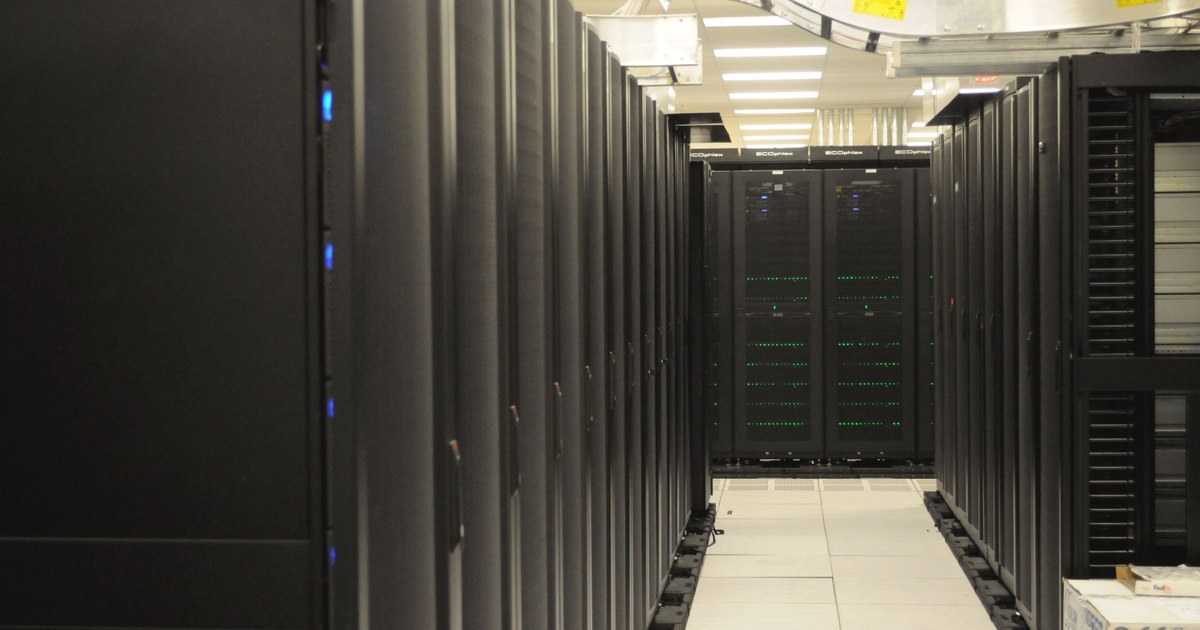
On November 16, 2026, NVIDIA announced a rack-scale Vera CPU platform for scientific computing and AI-related workloads. It combines 192 Vera CPUs with Quantum-X800 InfiniBand networking, liquid cooling and a claimed aggregate peak memory bandwidth above 200 TB/s. This is a CPU platform: the announcement does not describe 192 GPUs or make the rack a drop-in substitute for a GB300 NVL72 inference system.
NVIDIA expects Vera CPU racks from Dell Technologies, HPE, Lenovo and Supermicro beginning in early 2027. That is a vendor forecast, not a confirmed price, configuration or delivery commitment for a particular region. Buyers should start by measuring which portions of their work are limited by CPUs, memory or network communication and which still require GPUs.
What NVIDIA announced at SC26
The November 16 announcement positions the Vera CPU rack for modeling, simulation and scientific AI workflows. NVIDIA describes 192 processors, approximately 300 TB of memory and one petabyte of storage per rack. It says each 1U tray integrates eight Vera CPUs, NVMe storage and management.
| Item | NVIDIA's announcement | Confirm for a specific offer |
|---|---|---|
| CPUs | 192 Vera processors per rack | Actual count and available configurations |
| Tray | Eight CPUs in 1U | Tray components, power and storage placement |
| Memory | Approximately 300 TB per rack | Installed and usable capacity for the chosen SKU |
| Network | Quantum-X800 InfiniBand | Ports, topology, switches and cables |
| Cooling | Fully liquid-cooled | Loop boundaries, CDU and facility requirements |
| Timing | Partner racks expected from early 2027 | Real availability and regional terms |
The platform reuses some NVL72 rack components, including chassis, power distribution and cooling infrastructure, according to NVIDIA. Shared rack components do not make the CPU rack equivalent to a GB300 GPU platform. Check the processors, accelerators and interconnect in the exact design being quoted.
Interpreting cores and memory bandwidth
NVIDIA lists 88 custom Olympus cores and 176 threads per Vera CPU. Multiplying by 192 gives 16,896 nominal cores and 33,792 threads for a fully populated rack. This is arithmetic, not a performance measurement. It does not show how much of the system one application can use, how resources are allocated to system services or how network synchronization affects throughput.
The company lists up to 1.2 TB/s of memory bandwidth per CPU and more than 200 TB/s of aggregate peak bandwidth per rack. Multiplying 192 × 1.2 yields 230.4 TB/s as a simple sum of per-CPU maxima. A single process will not automatically see that bandwidth: memory is distributed across CPUs and nodes, and remote access, data placement and communication depend on the software and topology.
Likewise, approximately 300 TB across the rack is not automatically a single local memory pool for every program. Ask how the workload partitions its data, synchronizes and communicates. Distinguish the vendor's decimal capacity units from values reported by an operating system, and confirm the installed modules in the particular configuration.
Where a CPU rack can complement GPUs
An AI pipeline includes more than accelerator kernels. CPU resources may handle data loading, preprocessing, databases, orchestration, agent logic or portions of a scientific simulation. A project may run simulation stages on CPUs and model training or analysis on a separate GPU system. The right division depends on the application, data and software.
Map and measure each stage. If GPUs wait while CPUs prepare inputs, additional host capacity may help only when preprocessing is genuinely the bottleneck and the storage and network can deliver data at the required rate. If the bottleneck is elsewhere, buying more CPU capacity alone will not fix it.
For an illustrative sequential workload, suppose preprocessing takes 40 minutes and GPU computation takes 20 minutes, with no overlap. Halving preprocessing would reduce total time from 60 to 40 minutes, not by half. This is a dependency calculation, not a Vera benchmark; a pipeline that overlaps stages needs a different model.
Record where models and data reside, how many jobs or requests run concurrently and how the stages exchange results. Check the required libraries and file formats. For a mixed CPU/GPU deployment, application compatibility, network latency and operational responsibility can matter as much as individual peak specifications.
Keep vendor benchmarks in context
NVIDIA reports its own OpenFOAM motorBike Large comparison, claiming 1.9 times the performance and 2.4 times the performance per watt of x86 systems under its stated test conditions. It separately describes projected gains for the Weather Research and Forecasting model. Those figures are neither independent results nor a universal prediction for scientific applications or inference.
Request the detailed CPU and memory configuration, networking, compiler version, problem size and energy-measurement method. A change in workload size or settings can explain differences that should not be attributed solely to processor architecture. Prepare a reproducible input set and a correctness criterion for your own application, then measure completion time and energy per unit of useful work.
Label projections as projections. If code relies on a particular instruction set or proprietary dependency, verify the build and vendor support on the proposed platform before making procurement commitments. A successful demonstration of one application does not establish support for all binaries.
Facility and procurement checks
The fully liquid-cooled design needs a compatible facility connection, coolant distribution, monitoring and maintenance procedures. The press release is not a complete specification for every shipping rack. Obtain power, coolant temperatures, pressure limits and responsibility boundaries for the exact SKU rather than copying requirements from a different NVL72 system.
The site team also needs rack dimensions, weight, electrical feeds, redundancy, thermal balance and floor-load documentation. For networking, ask for the switches, adapters, topology, cable lengths and available ports. Agree who maintains the CDU, installs firmware updates and supplies replacement parts.
Compare complete offers including cooling, networking, software support and electricity under confirmed local conditions. A partner availability forecast is not a guarantee of price or delivery in your market.
What to include in a supplier request
- Applications, library versions, code architecture, input sizes and completion-time targets.
- CPU and GPU resource needs and the exchange between pipeline stages.
- Processor count, installed memory and storage in the proposed rack.
- Network topology, qualified switches and cables.
- Documented power, cooling, installation and maintenance requirements.
- A reproducible comparison using the same inputs, correctness checks, time and energy metrics.
- Confirmed warranty, price, availability and delivery terms for the relevant region.
For an infrastructure discussion based on your workload, explore the AI server catalog or describe the project. Configuration and commercial terms must be confirmed separately; the NVIDIA announcement is not an AI Server Lab quotation.