
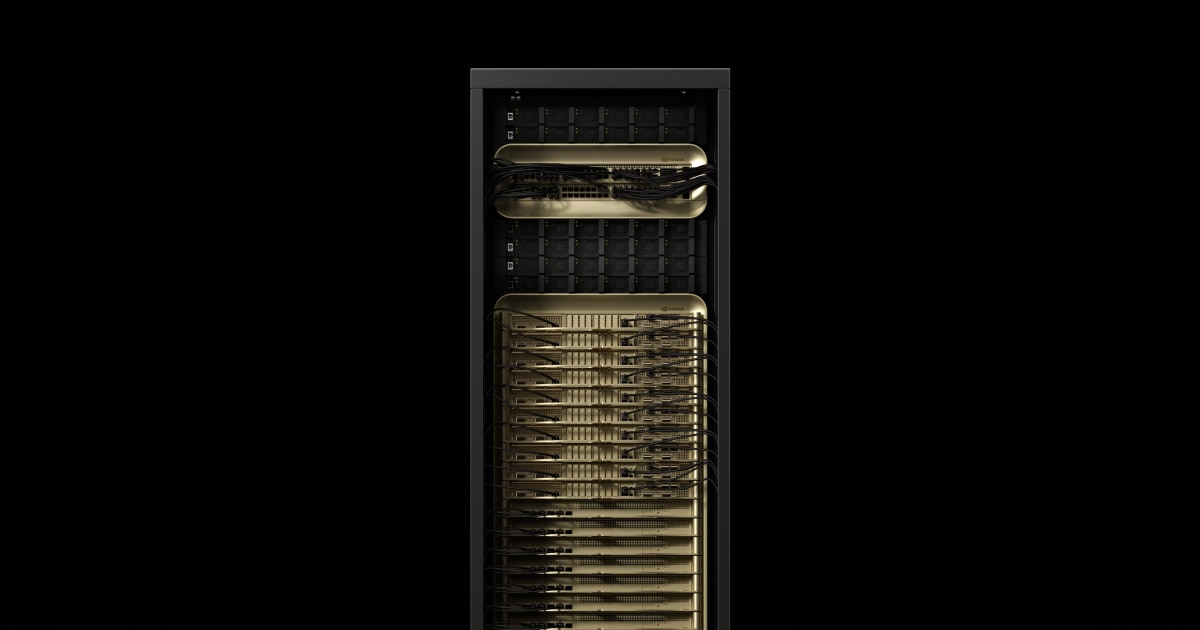
GB300 NVL72 is a rack-scale NVIDIA Grace Blackwell Ultra platform, not a conventional eight-GPU server. NVIDIA describes a configuration connecting 72 Blackwell Ultra GPUs and 36 Grace CPUs with NVLink. A useful feasibility study covers the complete rack, facility power, liquid cooling, network, floor capacity and service arrangements—not GPU specifications alone.
The configuration below describes NVIDIA's reference platform. An OEM's delivered system can differ in components, implementation and support. This guide does not establish availability, price, delivery or regulatory eligibility in any country.
Understand the rack as a system
NVIDIA's GB300 NVL72 product information identifies the 72-GPU, 36-CPU arrangement and its rack-scale NVLink fabric. Compute trays, switches, cabling, power distribution and cooling work together. This is different from simply installing 72 interchangeable PCIe accelerators in existing servers.
Ask the vendor for the exact rack bill of materials, compute-tray count, included switches, optics and cables, software and management components. Document what the integrator provides and what the facility must supply. A reference architecture is a starting point for design, not a substitute for an agreed SKU and engineering drawings.
Distinguish GPU fabric from the external network
NVLink connects components inside the platform as specified by the design. External Ethernet or InfiniBand provides paths to other systems, storage and clients; its topology, bandwidth and redundancy must be sized separately. Do not add interface headline speeds and assume an application receives that total as useful throughput.
Map the workflow's traffic: GPU-to-GPU exchanges, access to training data, checkpoint writes, model downloads and service requests. Ask the integrator for port allocation and a representative network design. Measure a pilot workload with the intended collective communication and storage paths, not just an isolated synthetic link.
Establish the power and cooling boundary
Request the maximum electrical input for the exact delivered rack, voltage and phase requirements, connectors, distribution and redundancy. Clarify whether numbers refer to IT equipment only or include cooling equipment and losses. The facility engineer must check cable sizing, protection, available capacity and local rules for the actual installation.
For an illustration, a rack averaging 100 kW for 24 hours uses 2,400 kWh at the rack measurement boundary. This is not a GB300 specification or guaranteed consumption. Costs also require the local tariff, utilization and any facility overhead. A peak capacity requirement is different from an average-energy calculation.
For liquid cooling, obtain approved supply and return temperatures, flow, pressure, coolant quality, quick-disconnect and leak-detection requirements from the OEM. Confirm heat rejected to room air, the distribution unit's role, redundant cooling and what happens if a pump or a facility loop fails. Do not assume a data centre supporting another liquid-cooled rack can accept this one unchanged.
Check physical installation and recovery
Verify rack dimensions, shipping splits, gross and operational mass, lifting points, route through doors and lifts, anchoring, floor loading and front/rear service clearance. Agree who connects power and coolant and who supervises commissioning. Account for network and coolant routing rather than assuming that unused rack units are free space.
Before delivery, define health checks, firmware and driver versions, topology discovery, thermal monitoring, fault handling and a workload-based acceptance run. Agree on logs, a stop condition and how failed components are repaired or replaced. Use NVIDIA's current platform documentation alongside the system OEM's manuals.
Information to provide in an RFQ
State the application and model, expected utilization, target deployment country, existing network and storage, rack location, power and liquid-cooling capacity, and required availability. Request a documented facility assessment and explicit warranty and support scope. Ask the supplier to identify any prerequisites or excluded installation work.
Explore the AI Server Lab catalog or send facility constraints and a workload description through the contact form. The exact system and commercial terms require confirmation for the intended market.