
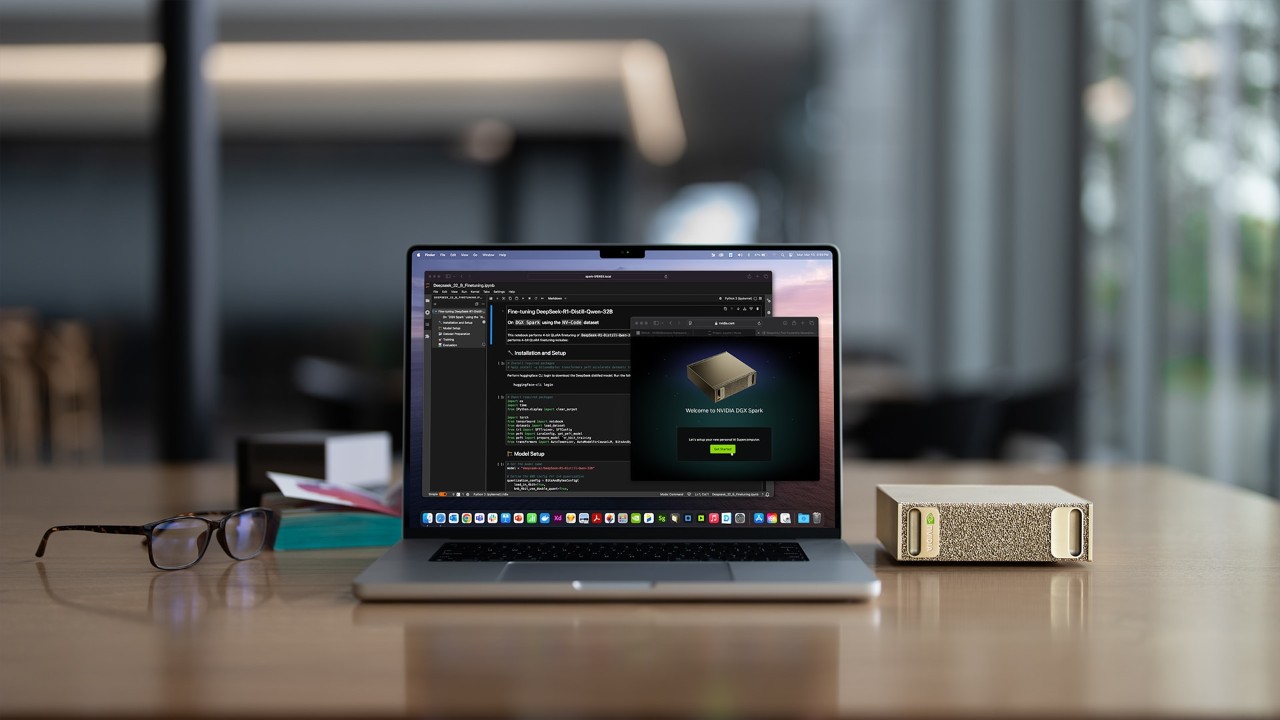
NVIDIA DGX Spark is a compact system based on the GB10 Grace Blackwell platform for local AI development and experimentation. NVIDIA lists 128 GB of unified system memory. The CPU and GPU share that installed memory with the operating system and applications, so it is not 128 GB of dedicated GPU memory in addition to system RAM.
It can be useful for prototyping and testing suitable AI workloads locally. Whether a particular model meets a latency, quality or concurrency target depends on its format, runtime and the full workload. The example calculations in this guide are illustrative, not AI Server Lab measurements.
What NVIDIA specifies
NVIDIA's DGX Spark product page describes the GB10 platform, unified memory and available networking and software. Exact storage and accessory configurations should be checked in the proposal for the buyer's market. Do not infer a supported price, delivery date or local availability from a different country's offer.
Unified memory can simplify development where the software supports the intended workload, but installed capacity is not the same as free capacity. The operating system, framework, model weights, cache and temporary allocations all use resources. Observe peak use with the actual versions and configuration.
NVIDIA also publishes a DGX Spark user guide covering setup and operating details. Check current compatibility for the model, software and operating environment rather than assuming that every CUDA application or quantization format behaves identically on every system.
Make a memory budget
Suppose a model's loaded weights need 65 GB, active request cache 18 GB, workspaces 9 GB and operating-system plus service overhead 12 GB. The sum is 104 GB under those assumptions. It is below 128 GB, but that arithmetic does not establish that a particular model fits: allocations can peak at different times, cache grows with context and concurrency, and software can reserve memory differently.
First load the exact checkpoint, quantization and engine version; then measure peak memory during representative requests, including long contexts and concurrent users. Leave a margin for the operating environment and changes in workload. Verify output quality when comparing quantized models.
Do not equate unified capacity with memory bandwidth or inference speed. A model that fits can still respond too slowly for an interactive service. Conversely, throughput measured with a large batch may not describe first-token latency for a single user.
Local development versus a shared server
A compact development system can help an individual team iterate on model integration, retrieval, fine-tuning or evaluation without moving every experiment to a rack. Check model support, physical security, backup and remote access. Local processing alone does not establish a security or privacy guarantee; policies and configuration still matter.
A GPU server can offer different accelerator counts, network interfaces, service arrangements and isolation options. It can also require rack power, cooling, site preparation and centralized administration. Compare the exact devices and complete systems against the expected work, not simply installed memory or a peak AI performance figure.
For interactive inference, record time to first token, generation speed, end-to-end latency and errors at the target concurrency. For batches, count successfully completed, quality-checked jobs per hour. Keep the same model, input distribution, output limits and evaluation criterion across systems where possible.
Consider connected systems carefully
NVIDIA describes multi-system options in its documentation. Multiple machines do not automatically act as one larger local GPU, and network capacity does not replace local memory bandwidth. A distributed workload must support the intended topology and tolerate its communication overhead. Document the network, software version and actual scaling on your task.
As an example, if a job takes 100 minutes on one device and 60 minutes on two, speedup is 100 / 60, or about 1.67. Relative to ideal doubling, efficiency is about 83%. These are made-up values to explain the calculation; they do not describe DGX Spark performance.
Questions to ask before buying
- Which model revision, precision and runtime will be used, and are they supported?
- What are the peak memory and latency at the intended context and concurrency?
- Are storage, networking, accessories and remote-management features included?
- What physical environment, backup plan and support process does the team require?
- What are the actual warranty, price and delivery terms in the destination country?
For comparison with other infrastructure, see the AI Server Lab catalog and provide the workload and operating constraints in the contact form. Confirm the exact configuration and commercial terms separately.