
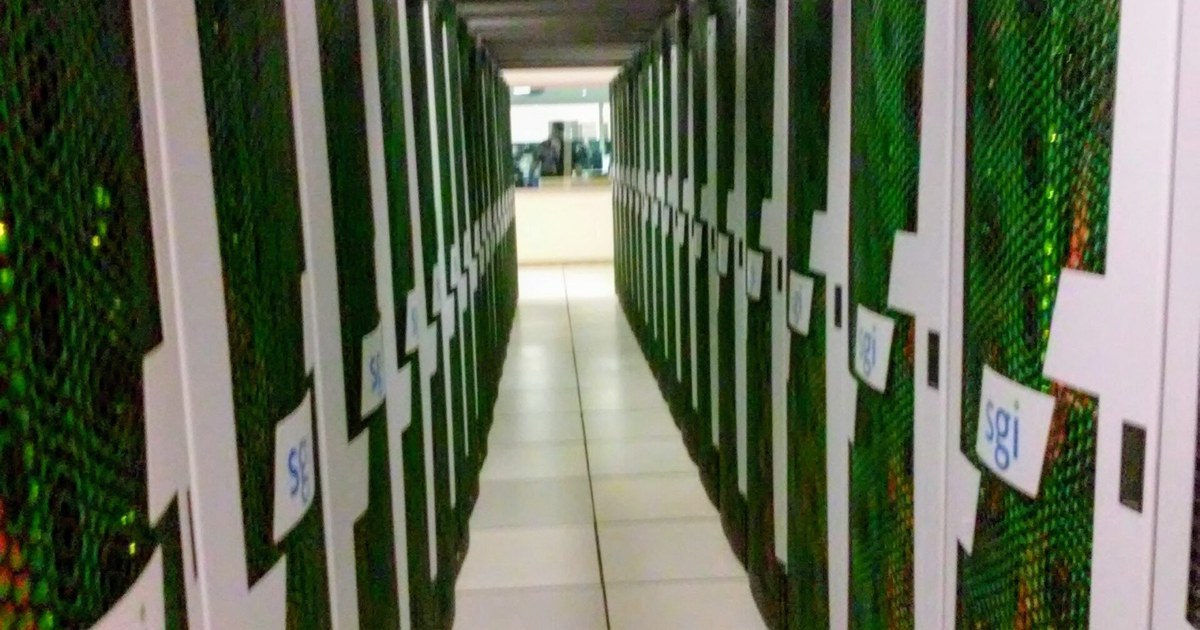
At SC26 in Chicago, MiTAC showed a 52U liquid-cooled rack with 12 G4826Z5 servers and 96 AMD Instinct MI355X accelerators. This is a demonstrated rack configuration using an existing server family, not an announcement of a new GPU model.
The meaningful question is how the complete installation meets power, cooling, network and workload requirements. A trade-show demonstration does not establish local price, stock, delivery or warranty terms.
What is confirmed
MiTAC's SC26 announcement describes 12 G4826Z5 servers and 96 MI355X GPUs in a 52U rack. It claims 50% greater GPU density than conventional deployments, but the brief announcement does not specify a sufficiently complete baseline for an independent general comparison. Treat that number as a vendor claim, not a universal outcome.
The MLCommons description of the G4826Z5 describes a 4U server with eight MI355X GPUs and dual AMD EPYC 9755 or 9575F CPUs. Confirm the CPUs, memory, NICs and storage of any actual proposal: the SC26 notice does not give the full bill of materials for the displayed rack.
The system is being shown at a US industry event. The announcement does not establish that the same configuration is available in every market or has passed a particular site's acceptance process. Confirm support and commercial conditions for the destination country.
Rack height and density
The advertised counts are arithmetically consistent: 96 GPUs divided by 12 servers is eight GPUs per server. At 4U per server, the 12 chassis account for 48U of a 52U rack, leaving a 4U difference. That difference should not be described as free space: switches, power distribution and other components can occupy it. Confirm the actual layout with MiTAC.
For a fair facility comparison, define whether GPU density includes required network and power equipment. If a network switch sits in a neighboring rack, account for that space separately. Also check depth, installed and shipping mass, service access, floor loading and delivery paths. Height alone does not prove that a rack fits a data centre.
Per-device and aggregate memory
AMD lists 288 GB of HBM3E per MI355X. Multiplying gives 2,304 GB, or 2.304 TB decimal, across eight GPUs in a fully populated server; 96 GPUs total 27,648 GB, or 27.648 TB decimal.
Those totals describe separate device memories. They do not guarantee a single local memory pool for any application. Distributing a model requires a compatible runtime and a suitable interconnect; caches, workspaces and replicated data also consume capacity.
As a hypothetical device budget, 200 GB of weights plus 35 GB of cache and 20 GB of buffers totals 255 GB before additional headroom. It is not a MiTAC measurement or proof that a specific model fits. Measure peak allocations with the intended model format, context length and concurrency.
Electrical and cooling boundaries
AMD lists 1,400 W typical board power for MI355X. Multiplying 96 × 1.4 kW gives 134.4 kW for the GPUs alone at that specified figure. This is not a measurement or confirmed operating setting for the displayed rack. CPUs, system memory, NICs, drives, cooling equipment and power conversion add further loads; the actual configuration and its limits must come from the integrator.
Request full-rack maximum input power, voltage, connectors, power distribution, redundancy and behavior if one supply path fails. The site engineer must check circuit and protection capacity for the actual installation. Average operating energy and peak facility capacity are different calculations.
The announcement calls the rack liquid cooled but does not provide a complete coolant or heat-rejection specification. Obtain inlet and outlet temperatures, flow and pressure, fluid requirements, connections, air-side heat, leak detection and the division of responsibility for the CDU. Plan how running jobs are stopped and restored if the cooling loop fails.
MiTAC separately describes a two-phase cooling proof of concept with ZutaCore. Its claimed characteristics should not be applied to every G4826Z5 rack or facility without the relevant configuration and measurement boundaries.
Measure the intended workload
For training, fix model and data versions, precision, effective batch, step time and checkpoint schedule. For inference, record input and output distributions, concurrency, first-token and end-to-end latency, throughput and errors. Compare results at the same quality threshold.
Measure one server first and then multiple nodes with the intended network and storage. A strong eight-GPU result within a node does not establish scaling across 12 servers. Request the NIC and switch topology and the exact ROCm, driver and framework versions. Evaluate energy per successfully completed task only after defining the measurement boundary and obtaining actual measurements.
How to interpret the density percentage
A percentage needs a defined baseline. If a hypothetical comparable rack had 64 GPUs, 96 / 64 = 1.5, or 50% more. The 64-GPU figure is only an arithmetic example; MiTAC's brief announcement does not identify it as the comparison baseline. Ask for the height, rack contents, network, power limits and inclusion rules of both systems.
Even a valid density comparison does not prove every GPU can operate at peak simultaneously. That depends on the actual system's power, cooling and software limits and should be checked in an agreed pilot.
Information to request
Ask for exact server and accelerator SKUs, rack contents, network and power diagrams, coolant requirements, installed mass, software support, acceptance procedure, warranty and replacement process. Confirm availability, configuration, price and delivery in the target market.
Explore the AI Server Lab catalog or send workload and site requirements through the contact form.