
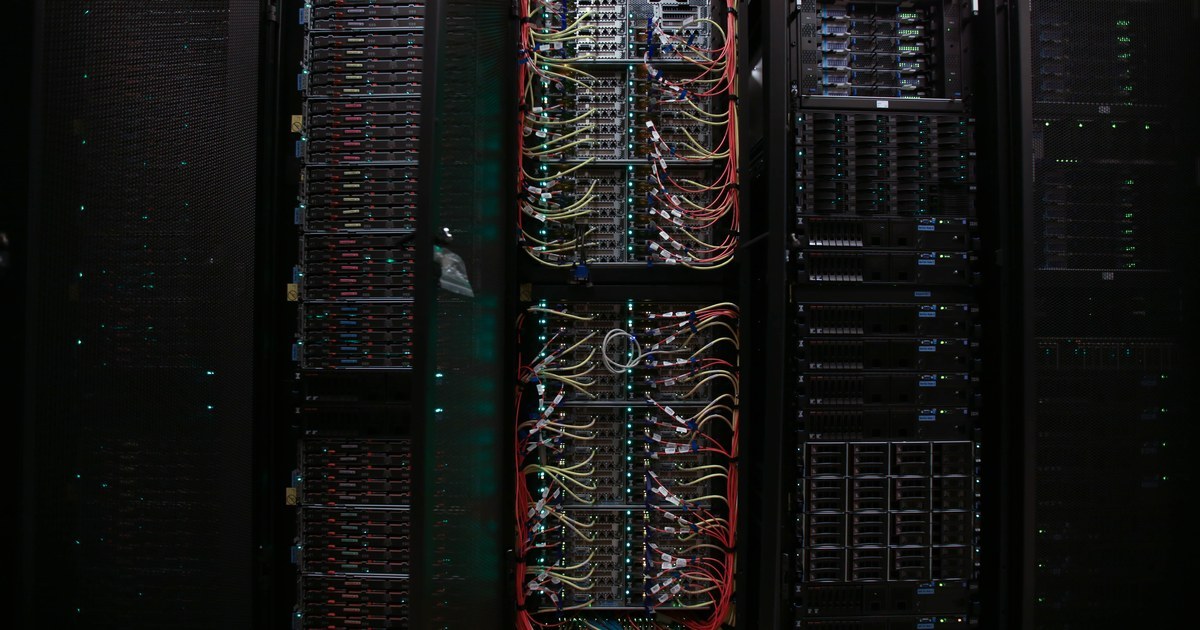
LIQID is showing UltraStack with AMD Instinct MI350P accelerators attached to one AMD EPYC server through external chassis and a PCIe fabric at SC26. The vendor describes configurations from four to 30 GPUs, each with 144 GB HBM3E. This can host multiple models under one operating system, but aggregate device memory does not automatically become one local memory pool.
LIQID says systems are available in selected markets; that does not establish price, stock or delivery elsewhere. The company publishes its own inference measurements up to 20 GPUs and a projection for 30. Treat the projection separately and validate a proposed configuration on the intended workload.
The described system
In its UltraStack description, LIQID lists a dual-socket AMD EPYC 9005 Supermicro server, external GPU chassis, host adapters and MI350P accelerators. Different fixed configurations are offered; chassis, licensing and support must be checked in the actual quote.
LIQID's 12 November SC26 article discusses placing separate models on separate GPUs and showing the system in Chicago. An announcement and exhibition do not establish commercial availability for every configuration and region.
LIQID describes MI350P as an air-cooled PCIe card with 144 GB HBM3E. It is not the same implementation as MI355X in the Lux system. Similar names do not make form factors, topology or specifications interchangeable; verify the exact SKU.
Memory across four or 30 GPUs
The nominal arithmetic is 4 × 144 = 576 GB HBM3E and 30 × 144 = 4,320 GB, or 4.32 TB in decimal units. This is a sum of 30 separate devices, not a guaranteed contiguous application allocation. Runtime and driver overhead reduce usable capacity.
When each GPU runs one model, each replica must fit alongside cache, buffers and other allocations. If a model must be split, confirm that the engine and PCIe topology support it and measure communication overhead. Device count alone does not establish efficient execution of one large model.
Suppose a hypothetical model uses 85 GB, cache 25 GB and buffers plus reserve 15 GB. The preliminary sum is 125 GB per GPU. This is an illustrative calculation, not proof that a particular model runs on MI350P. Measure peak memory at the actual precision and concurrency.
Measured results versus a projection
In its benchmark brief, LIQID describes its own 7B-class FP4 test with one model per GPU and concurrency 128. It reports roughly 89,000 output tokens per second on 20 GPUs. The approximately 133,000 figure for 30 GPUs is identified as a projection based on scaling through 20 devices.
Do not present the projection as a measurement on 30 cards or apply it to another model, prompt length or latency target. These are vendor-reported results, not independent AI Server Lab tests. Request the exact model and software versions, input/output profile and reproduction method.
For a rough arithmetic check, 89,000 / 20 is 4,450 tokens per second per GPU on average; multiplying by 30 yields 133,500 if that average remains constant. Real scaling can differ. The calculation explains the extrapolation, not a guaranteed result.
One host and multiple chassis
A shared host and external chassis reduce the number of independent hosts in the described layout, but add dependence on that CPU node, the PCIe fabric and management software. A shared-component failure can interrupt several models. Define availability requirements and a recovery configuration.
Ask for the GPU-chassis connection diagram, lane allocation, switches, supported topology and expansion procedure. Concurrent teams can also saturate shared host or storage paths. Measure host CPU load and latency under realistic simultaneous work, not just aggregate token throughput.
For separate models, compare completed requests within a latency target. For one model split across devices, inter-GPU communication and the engine matter. The two scenarios should not use the same unqualified linear-scaling assumption.
Power and cooling
LIQID lists up to 600 W per MI350P GPU with configurable operation; verify the supported power profile in the offer. Thirty devices at 600 W sum to 18 kW for GPUs alone. This is not the total UltraStack draw: the host, chassis, fans and power losses are additional.
The vendor describes air cooling and provides system-power estimates. For facility acceptance, request the maximum input power of the exact configuration, PDU and voltage requirements, airflow and service clearance. Check the supported load when one power supply or feed fails; multiple supplies alone do not prove a particular redundancy level.
How to compare alternatives
Specify model and weight versions, precision, input/output lengths, concurrent users and latency limits. Run the same request set on each candidate and capture throughput, time to first token, errors, memory and full-system energy. Verify output quality after quantisation.
Include host, external chassis, networking, licensing and support over the same period. Account for rack space and maintenance of the complete system. Confirm price and delivery for the actual region and order date.
Explore the AI Server Lab catalog or describe the workload to discuss AMD or NVIDIA configurations. Availability and delivery terms require confirmation.