
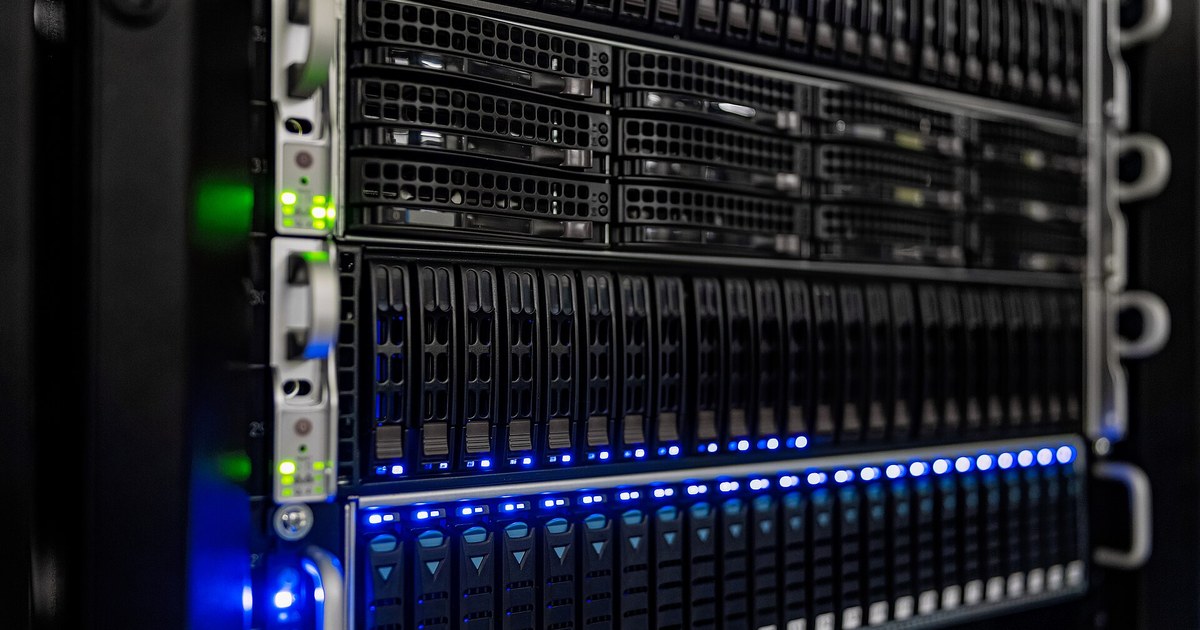
The practical answer: Lenovo describes the ThinkSystem SR755 V5 as a single-socket 2U server with a sixth-generation AMD EPYC processor and support for up to two single-width or two double-width GPUs. Its November 10, 2026 datasheet lists 16 DDR5 memory channels and up to 16 front E3.S drives. This is a server platform, not an accelerator and not an automatic substitute for an eight-GPU node. The document does not confirm the availability, price or delivery date of a particular build in Russia.
The purchasing question is whether that balance of CPU, memory and accelerators fits the workload. Evaluate the SR755 V5 as a CPU-led server that can accommodate a limited number of compatible GPUs. If a model requires eight tightly interconnected accelerators, compare purpose-built alternatives and do not transfer their connectivity assumptions to this chassis.
What Lenovo disclosed
Lenovo Press published datasheet DS0214 on November 10, 2026. It lists the platform's processor, memory, expansion, storage and GPU limits. Lenovo describes a commercial enterprise and data-center system; that is not evidence that every option is in stock in every region.
AMD previously announced availability of EPYC 9006 SP7-based platforms. The SR755 V5 document adds a specific chassis to that broader processor story: socket count, expansion and accelerator limits can now be checked against the intended deployment. Neither announcement supplies a complete bill of materials. Ask for the exact motherboard, CPU, DIMM, drive, GPU and network-adapter part numbers in a proposal.
Platform limits are not a bill of materials
| Area | Lenovo's published limit | What to establish in the quotation |
|---|---|---|
| Form factor | 2U rack server | Depth, weight, rails and maintenance clearances |
| CPU | One sixth-generation EPYC processor, up to 256 cores | Exact model, power envelope and OS support |
| System memory | Up to 16 slots and 16 channels; up to 4 TB | DIMM type, capacity, population and supported speed |
| GPUs | Up to two single-width or two double-width GPUs | Supported part numbers, brackets, power and cooling |
| Storage | Up to 16 front E3.S drives and two boot M.2 devices | Installed bays, drives, interface and protection |
| Expansion | Up to six PCIe Gen6 x16/x8 slots | Actual risers, electrical lanes and occupied slots |
| Power | 1+1 options | PSU rating, redundant capacity and feed design |
“Up to” describes a ceiling, not a standard delivery. Sixteen memory slots do not mean that sixteen modules are installed. Support for two double-width cards does not establish that every card of that physical width is supported. The exact Lenovo GPU part number, mounting hardware and thermal profile must match the ordered chassis.
Why the host matters in an AI deployment
Not every stage runs on a GPU. The CPU may accept requests, preprocess data, serve retrieval systems, execute an agent's tools and move results between components. CPU capacity and memory bandwidth can therefore affect the whole application, but their contribution depends on the software and traffic profile.
Consider a local inference service running alongside a retrieval process on the same node. Measure CPU and RAM usage for each component at peak concurrency, and leave capacity for the serving runtime and operating system. The maximum core count in a processor family is not the core count of every SKU, and an application does not necessarily scale linearly with additional cores.
Before comparing offers, write down the target workload: concurrent tasks, latency, input and output sizes, available software and acceptable maintenance window. A representative benchmark is preferable to treating a headline core count as a performance guarantee.
Is a two-GPU ceiling enough?
One or two supported accelerators can be appropriate for some local AI services, while other models or training tasks may require a different class of platform. Determine model size, numerical precision, KV-cache requirements, concurrency and software support. The memory on two cards is not automatically a single contiguous pool available to every application.
Check the exact Lenovo GPU options, electrical lanes, occupied slots, power connections and supported driver. If high GPU-to-GPU exchange is required, obtain the actual topology and supported interconnect for the proposed configuration. The phrase “up to two GPUs” does not determine how they communicate or predict a model's performance.
Compare complete builds rather than just chassis labels: this 2U server with specified cards, and an alternative multi-GPU platform with its own bill of materials. Include network, electrical and cooling requirements, service scope and expected utilisation. Use actual quotations for cost comparisons; public headline prices are not a substitute for confirmed local terms.
Memory, E3.S storage and PCIe
Lenovo specifies up to 16 memory slots and 16 channels for the single-socket system. With fewer DIMMs, their population across channels can matter. Check the supported module type and population rules for the selected CPU. The advertised 4 TB ceiling may require specific DIMMs, so confirm the installed parts rather than assuming maximum capacity.
For E3.S drives, request the compatible front bay configuration, physical interfaces, installed drives and the service procedure. Two boot M.2 positions do not mean that mirroring is already configured. Confirm the required controller, supported RAID or software configuration and recovery method. For datasets, measure throughput, latency and write endurance against the workload.
The stated maximum of six PCIe Gen6 x16/x8 slots also requires a concrete riser and lane diagram. Map GPUs, network adapters and storage controllers before approving the BOM. If OCP adapters are needed, ask which bays and enabling parts are included. A maximum slot count does not prove that every option can be populated simultaneously.
Power and site readiness
The SR755 V5 is described as air cooled. That does not make it suitable for every room: the chosen CPU, GPUs, power supplies and inlet conditions determine the final envelope. Request the maximum power and heat figures for the exact build, the required airflow and supported redundancy modes.
A 1+1 arrangement describes redundancy, but surviving capacity depends on the installed PSU rating and operating conditions. Do not add two PSU nameplate ratings and call the total redundant capacity without checking the manufacturer's configuration. A qualified facility engineer should review the electrical feed, phase distribution and cooling.
Questions before ordering
- Which CPU, DIMMs and GPUs are included by part number?
- Does Lenovo support those GPU options in the proposed chassis and thermal configuration?
- What PCIe topology remains for networking and storage after the cards are installed?
- Which E3.S drives, boot protection components and spares are supplied?
- What are the confirmed power, airflow, rack and service requirements?
- Which OS, driver and application versions are supported?
- What seller, availability, price, delivery and warranty apply in the destination country?
Explore the AI server catalog or describe your workload through the contact form. AI Server Lab confirms the exact configuration and commercial conditions separately for each request.