
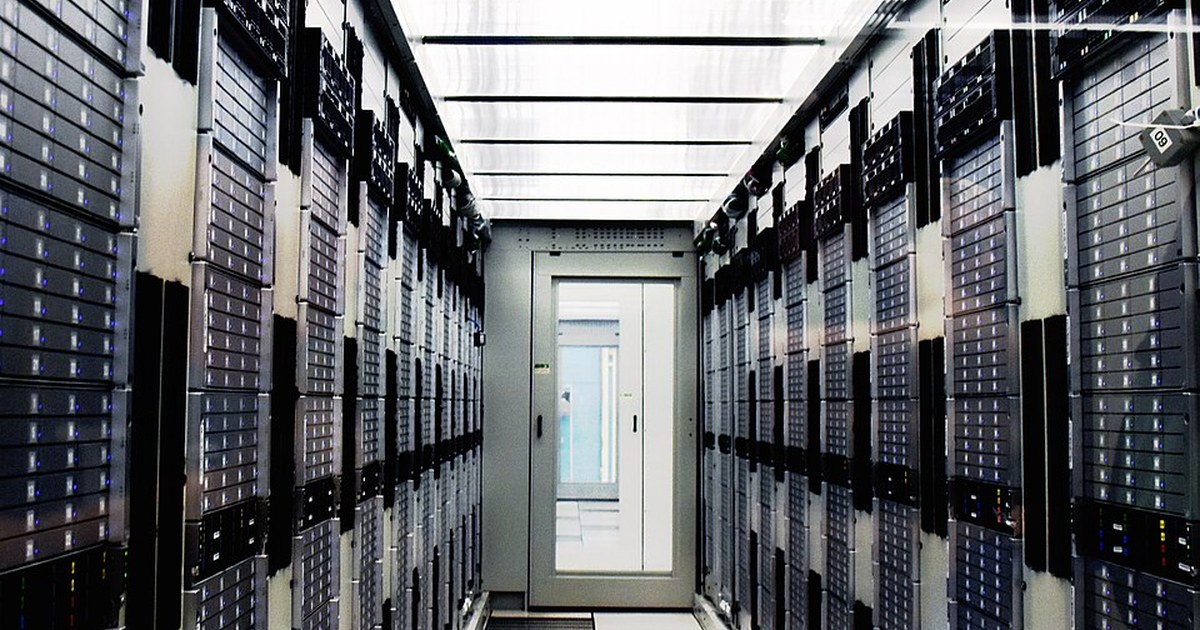
The practical answer: Lenovo describes HGX Rubin NVL8 as a 2U server with eight NVIDIA Rubin GPUs, four NVLink switches and direct liquid cooling. A compatible 48U MGX rack can hold up to nine such nodes, equivalent to 72 physical GPUs. That count does not establish a single rack-wide NVLink domain or a shared memory pool. Lenovo published its detailed product guide on November 10, 2026. It describes a commercial platform, but does not establish the delivery date, price or availability of a particular configuration in Russia.
The first buying question is whether the facility can support the complete system. Lenovo's guide lists a 24 kW system-power figure for one server and describes dedicated rack power and direct liquid cooling. A 2U enclosure is therefore not automatically interchangeable with an ordinary air-cooled server occupying the same rack space. The sizing example below is deliberately separate from a measured workload or a vendor quote.
What was published
Lenovo Press published product guide LP2528 on November 10, 2026. It covers the Lenovo implementation of NVIDIA's HGX Rubin NVL8 reference architecture, including compute, networking, the rack and service considerations. The shorter DS0216 datasheet is dated November 3.
These documents are vendor specifications, not proof that a specific build is in local stock. Treat pricing, ship dates, seller, warranty and country-specific delivery terms as unconfirmed until a written offer is issued for the exact SKU. Do not assume that another manufacturer's implementation has every feature or option described here.
Configuration at a glance
| Area | Lenovo's documented platform | Procurement question |
|---|---|---|
| Accelerators | Eight Rubin SXM8 GPUs and four NVLink switches per node | Which GPU option and power mode are included? |
| Host | Two 64-core Intel Xeon 6 6776P processors | Is the CPU configuration adequate for the workload? |
| System memory | 32 DDR5 RDIMM slots, up to 4 TB | Which DIMMs, speeds and channel population are supplied? |
| Networking | Eight ConnectX-9 paths and a BlueField-4 DPU in the described design | Which optics, cables and fabric components are included? |
| Local storage | Up to eight E1.S drives and two M.2 boot devices | What are the installed capacity, endurance and protection scheme? |
| Cooling | Direct water cooling; the server is described as zero-airflow | Does the site meet coolant, connection and maintenance requirements? |
| Rack | Up to nine compatible nodes in a 48U MGX rack | What are the power, service-clearance and cooling boundaries? |
A maximum is not a statement of installed capacity. For example, up to 4 TB of RAM depends on the supplied DIMMs; up to eight drives does not mean that eight SSDs are included. Request a bill of materials with part numbers before comparing proposals.
The documentation is inconsistent about boot drives: the overview specifies two M.2 devices, while the boot-device options table lists E1.S part numbers. Sections also differ on hot-swap support. Confirm the exact boot device and service procedure with Lenovo for the quoted SKU rather than treating either interpretation as settled.
Lenovo lists GPU power options up to 1.8 kW DSX MaxLPS or up to 2.3 kW MaxP per GPU. These are not measurements of continuous application consumption. The selected mode, firmware, workload, host components and cooling system all affect actual power and performance. Likewise, the number of GPUs does not guarantee inference throughput or training time.
What NVLink connects—and what it does not prove
Lenovo states that eight GPUs within a node are connected through four NVLink switches. It separately describes a rack with up to nine nodes and ConnectX-9 networking. Multiplying the maximum node count gives 9 × 8 = 72 physical GPUs. It does not, by itself, prove that all 72 participate in one NVLink domain, nor does it make their memory a single automatically usable pool.
Ask for the topology diagram for the proposed configuration: which GPU-to-GPU paths stay inside one server, how nodes connect to each other, what switches and transceivers are required, and what software versions are supported. For distributed training, measure collective communication and scaling efficiency on the target workload. For inference, benchmark time to first token, output rate and concurrent requests rather than extrapolating from accelerator count.
Worked power example
For an initial conversation with the facility team, assume that each node simultaneously reaches the 24 kW system figure listed in the guide:
- One node: 1 × 24 kW = 24 kW.
- Four nodes: 4 × 24 kW = 96 kW.
- Nine nodes: 9 × 24 kW = 216 kW.
This is a simple capacity illustration, not a measured peak, a confirmed order specification or a complete facility power budget. It excludes conversion losses, network switches, pumps, start-up conditions and the effect of redundancy. Lenovo separately describes an approximately 225 kW sustained rack design. Do not treat the arithmetic difference as guaranteed headroom: the scope and operating assumptions for each figure must be confirmed against the ordered rack.
Similarly, adding the nameplate ratings of power shelves does not tell you how much capacity remains during a failure. Obtain a single-line electrical diagram and verify input voltage, current, distribution, redundancy and failure scenarios with the facility's qualified electrical engineer. Confirm which components are included in the quoted node and rack figures.
Facility cooling and service
The vendor describes the compute node as direct-water-cooled and zero-airflow. Its specification gives an inlet-water temperature up to 45 °C. That upper value does not mean any water below it is acceptable: flow, pressure, coolant quality, dew point, connectors and leak-detection arrangements still need to match the supplied system and facility design. Confirm the operating ranges for the exact configuration.
Liquid cooling also does not automatically eliminate room-level cooling. The product guide describes air-cooled power shelves, and other rack components may have different cooling requirements. Ask for a heat balance covering the entire rack, including the liquid circuit, equipment that rejects heat to room air, pumps and network hardware. The acceptance plan should identify responsibility for filling, testing, emergency isolation and service access.
When to evaluate this system
The platform may merit evaluation for large training, demanding inference and research workloads where an eight-accelerator node and a prepared liquid-cooling facility fit the project. Scaling in nodes can support staged planning, but a 2U height alone does not establish compatibility with an existing rack or cooling loop.
If the application is small, usage will be intermittent, or the facility lacks a compatible liquid circuit, first compare less dense alternatives against measured requirements. Higher accelerator count does not automatically mean better economics at low utilisation. Base the decision on target quality, latency, concurrency, power cost and operating conditions.
Questions to send with an enquiry
- Which model, precision, context length and workload profile will run on the system?
- What exact server, GPU, DIMM, SSD, network and power-shelf part numbers are included?
- What connects GPUs within a node and nodes across the rack?
- Which framework, driver and firmware versions are supported, and how will acceptance be measured?
- What power is required in normal and failure conditions, including conversion losses?
- What coolant, flow, connectors, leak monitoring and service procedures are required?
- What seller, availability, price, delivery route, warranty and documents apply in the destination country?
Explore AI server configurations or describe the workload in the contact form. AI Server Lab can discuss requirements and request a suitable configuration; the availability and commercial terms of any specific delivery need separate confirmation.