
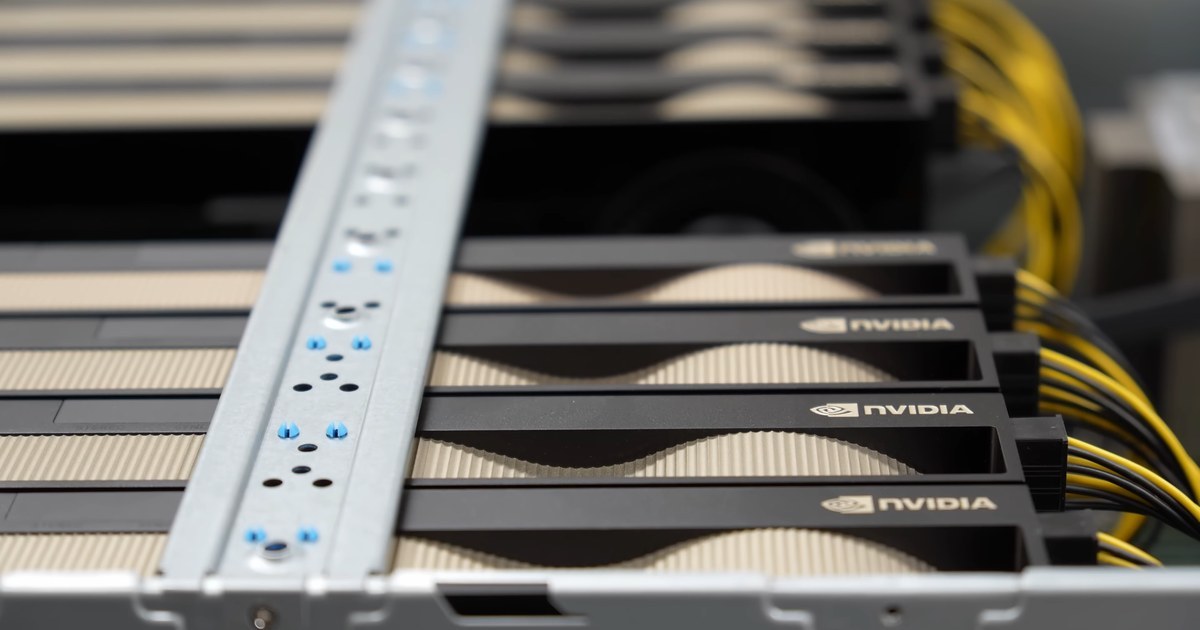
NVIDIA H200 NVL and RTX PRO 6000 Blackwell Server Edition fit different server configurations and have different memory capacities: NVIDIA lists 141 GB HBM3e for H200 NVL and 96 GB GDDR7 for RTX PRO 6000 Server Edition. More memory on one device can determine whether a model and context fit, but it does not automatically establish speed, cost or the best configuration for every workload.
Compare exact SKUs, model format, latency target and the complete server, including power and software. The calculations below are hypothetical rather than AI Server Lab benchmarks. Confirm commercial availability, price and delivery separately.
Specifications to compare
NVIDIA's H200 page distinguishes H200 SXM and H200 NVL. It lists 141 GB memory and configurable TDP up to 600 W for NVL. Do not automatically substitute SXM/HGX specifications for the PCIe NVL version; check the selected implementation and server documentation.
For RTX PRO 6000 Blackwell Server Edition, NVIDIA lists 96 GB GDDR7 with ECC and configurable power up to 600 W. Server Edition differs from Workstation and Max-Q in implementation and installation conditions. Compare the actual server edition and confirmed power profile.
NVIDIA's MIG table lists a maximum of seven instances for H200 NVL and four for RTX PRO 6000 Server Edition. This maximum does not mean arbitrary profile sizes can coexist or suit a specific model. Check valid profiles and driver versions.
What 141 versus 96 GB means
Nominal capacity differs by 45 GB per card. If a hypothetical application needs 105 GB for weights, cache and working state, that exceeds one RTX PRO 6000's nominal capacity but is below H200 NVL's nominal capacity. It still does not guarantee a successful H200 run: usable memory and peak overhead require measurement.
Suppose weights need 75 GB, cache 20 GB, buffers 7 GB and reserve 8 GB. The illustrative total is 110 GB. A 96 GB device would need a different supported format or placement scheme. The inputs are not specifications for a particular model.
Two RTX PRO 6000 GPUs provide 192 GB of nominal aggregate memory across separate cards. A single model needs a compatible distributed runtime and interconnect; some data may be duplicated and communication adds latency. Two independent replicas are possible only when each fits on one card.
Precision and output quality
H200 NVL uses Hopper and RTX PRO 6000 Server Edition uses Blackwell. Supported formats and optimised kernels vary with architecture and software release. Do not assume a model format is equally available and optimised on both.
NVIDIA NIM support matrices depend on a particular model and profile. One row is not a universal guarantee for every model. Check container version, minimum memory, GPU count and licensing.
If one configuration uses BF16 and another more aggressive quantisation, report answer quality alongside speed. Use a fixed evaluation set and criterion. Faster output at unacceptable accuracy is not the same useful work.
Distributed model or replicas
When a model fits on one GPU, independent replicas can serve separate requests. Otherwise, the engine may need model parallelism and inter-GPU communication. Exact topology depends on the server; available PCIe slots alone do not describe all paths.
Request the GPU, CPU, NIC and storage connection diagram. For H200 NVL verify the links in the proposed machine and the modes available to the application. For RTX PRO 6000 confirm server certification, cooling and power settings. Do not transfer HGX or other-model numbers without confirmation.
Imagine one replica handles 18 requests per minute within the target latency. Two independent replicas would ideally handle 36 if load were balanced and nothing else limited them. These are illustrative values, not H200 or RTX results. CPU, networking, storage and request-length variation can limit scaling.
Acceptance benchmark
Record model and weight revision, runtime, driver, precision and input/output lengths. Run the same questions and quality evaluation. Measure time to first token, generation speed, end-to-end latency and completed requests at expected concurrency. Save peak memory, errors and power settings.
Compare one and multiple concurrent users and repeat after warm-up. If configurations use different GPU counts, report results per server and whole-system power, not only per-card averages. Include network, licenses, cooling and support over a common ownership period using confirmed quotes.
Request exact host CPU, memory, power supplies, cooling and NICs. Confirm service clearance, chassis compatibility and GPU replacement procedures. Two cards with the same nominal maximum power do not necessarily fit the same server.
Decision
H200 NVL merits evaluation when single-device memory and its supported software stack are important. RTX PRO 6000 Server Edition has less nominal memory per card and a different architecture; assess it with the required model format and actual server. The choice depends on measured quality and latency within the complete project budget.
Explore the H200 catalog and AI Server Lab catalog, or send requirements through the contact form. Configuration and commercial terms require confirmation.